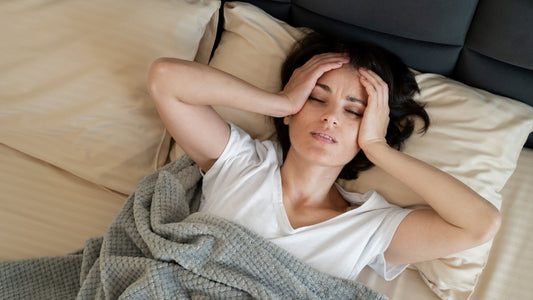
Hot flashes during the day are annoying. Hot flashes at night are devastating.
During the day, a hot flash interrupts a meeting or a conversation. At night, it interrupts the slow-wave sleep stage - the deepest, most restorative part of your sleep cycle - and pulls you back to the surface. You cool down. You fall back asleep. Twenty minutes later, it happens again.
After a few months of this, you do not just feel tired. You feel like a different person. Less patient. Less sharp. Less like yourself. The exhaustion that comes from chronically fragmented sleep is one of the most disabling experiences of perimenopause, and it is also one of the least discussed.
Why Hot Flashes Disrupt Sleep More Than Most Women Realize
When a hot flash hits during sleep, your core body temperature rises suddenly. The brain registers this as a threat and triggers a physiological arousal response - your heart rate increases, your skin vessels dilate, you sweat. This response is enough to pull you out of deep sleep even if you do not fully wake up.
The result is a measurable degradation in sleep architecture - less time in deep slow-wave sleep, more time in lighter sleep stages, and less REM sleep overall. Even if you sleep eight hours, the quality is so poor that you wake feeling completely unrested.
This is why the standard advice - "try melatonin," "avoid screens before bed," "keep your room cool" - is so insufficient for women in perimenopause. Those interventions address sleep hygiene. They do not address the underlying hormonal disruption that is causing the hot flashes that are destroying your sleep architecture.
What Drives Nighttime Hot Flashes
Hot flashes are triggered by estrogen fluctuation - specifically, by the hypothalamus becoming hypersensitive to small temperature changes as estrogen declines. This hypersensitivity narrows the thermoregulatory zone, meaning the body triggers a cooling response at temperatures that would not have bothered it before.
But the frequency and intensity of nighttime hot flashes are made significantly worse by several factors that natural approaches can address:
Elevated cortisol. Cortisol dysregulation is inflammatory, and inflammation lowers the threshold for thermoregulatory sensitivity. Women with high nighttime cortisol tend to have more frequent and more severe hot flashes.
Blood sugar dysregulation. Blood sugar drops during the night trigger cortisol release, which triggers the inflammatory response that makes hot flashes worse. Women who go to bed with unstable blood sugar often experience their worst hot flashes between 2 and 4am - exactly when the cortisol compensation spike is happening.
Systemic inflammation. The same inflammatory environment that drives weight gain and brain fog in perimenopause also drives hot flash frequency. Reducing the overall inflammatory load - through diet, supplementation, and stress management - consistently reduces hot flash severity over time.
What Natural Approaches Actually Help
Phytoestrogenic herbs. Kudzu root contains isoflavones that interact mildly with estrogen receptors, providing a gentle estrogenic signal that helps modulate the thermoregulatory hypersensitivity. The research on kudzu and hot flashes is more consistent than on soy isoflavones, and its traditional use in Asian medicine for menopausal symptoms has a long history.
Adaptogenic herbs. Maca root supports adrenal regulation of cortisol, which reduces the inflammatory environment that amplifies hot flash severity. Women who take maca consistently over four to eight weeks commonly report meaningful reduction in hot flash frequency. The mechanism is not estrogenic - it is adrenal and anti-inflammatory.
Magnesium. Research supports magnesium supplementation for hot flash reduction, likely through its effects on the nervous system and vasodilation. Magnesium helps regulate the vascular response that produces the flushing sensation, and its calming effect on the nervous system reduces the arousal response that hot flashes trigger during sleep.
Anti-inflammatory compounds. Quercetin, turmeric (curcuminoids), cat's claw, and broccoli all contribute to reducing the systemic inflammatory environment that amplifies thermoregulatory hypersensitivity. These are not primary hot flash treatments - they are support for the internal conditions that determine how frequently and severely hot flashes occur.
Blood sugar support. Cinnamon and other blood-sugar-supporting ingredients reduce the nighttime cortisol spikes that make hot flashes worse between 2 and 4am.
None of these approaches work overnight. The most consistent results from adaptogenic and anti-inflammatory support come after four to eight weeks of daily use. This is not a product limitation - it is the nature of working with the body's regulatory systems rather than suppressing symptoms acutely.
Why Most Natural Sleep Supplements Miss the Mark
Most natural sleep supplements contain one of two things: melatonin or valerian. Sometimes both.
Melatonin supports sleep onset. It does almost nothing for the sleep fragmentation caused by nighttime hot flashes and cortisol spikes.
Valerian acts as a mild sedative. It may help some women fall asleep but does not address the hormonal drivers of the nighttime waking.
Neither one addresses the hormonal environment that is causing the problem. They are symptom management, not root-cause support.
The supplements that produce meaningful, sustained improvement in hot-flash-driven sleep disruption are the ones that address cortisol regulation, estrogen receptor modulation, blood sugar stability, and systemic inflammation simultaneously - not a single sedating ingredient.
Dr. Anna's Approach
I formulated Nite-Zzz Caps specifically for this picture. Maca for cortisol and adrenal support. Kudzu for phytoestrogenic modulation. Magnesium for nervous system calming and hot flash reduction. Hops for sleep onset. Cinnamon for nighttime blood sugar stability. Quercetin, turmeric, cat's claw, and broccoli for anti-inflammatory support overnight. Tart cherry for natural melatonin precursors.
Non-habit forming. Two capsules in the evening. Results build over two to four weeks of consistent use.
"Within 3 days of starting this product, I was sleeping through the night without waking in a puddle of sweat. I've been using it for a month now, and I will never be without this product again." - Nicole O., Verified Buyer (Better Brain and Sleep)
"Night sweats seem to be less as well, which is amazing. Dr. Anna and her team really know how to target women's issues!" - Andrea S., Verified Buyer

For more on the hormonal mechanisms behind the 3am wakeup:
[Why You Wake Up at 3am and Can't Get Back to Sleep]
/blogs/sleep/why-women-wake-up-3am-perimenopause
Understand which sleep products address which specific challenges:
FAQ
Q: Do natural supplements help with nighttime hot flashes?
A: Research supports several natural approaches for reducing hot flash frequency and severity, including magnesium, phytoestrogenic herbs like kudzu, and adaptogenic herbs like maca that support cortisol regulation. Results are most consistent with four to eight weeks of daily use and vary by individual.
Q: Is melatonin effective for hot-flash-disrupted sleep?
A: Melatonin primarily supports sleep onset - falling asleep - not the sleep maintenance problems caused by nighttime hot flashes and cortisol spikes. For hot-flash-driven waking, approaches that address the hormonal environment are generally more effective.
Q: Why are hot flashes worse at night?
A: Hot flashes are driven by the hypothalamus becoming hypersensitive to temperature changes as estrogen declines. At night, cortisol dysregulation, blood sugar fluctuation, and the body's normal thermoregulatory processes during sleep create conditions that amplify that sensitivity. The result is hot flashes that are often more frequent and more intense during sleep than during the day.
Q: How long does it take for adaptogenic supplements to reduce hot flashes?
A: Most adaptogenic approaches show meaningful results in hot flash frequency after four to eight weeks of consistent daily use. This is the timeline for the adrenal and cortisol regulatory changes that drive the improvement.
Q: Can I take Nite-Zzz Caps with other sleep supplements?
A: Nite-Zzz Caps pair well with Better Brain and Sleep and Call it a Nite. The Sleep Products Chart at drannacabeca.com shows how each product in the Sleep Collection addresses different aspects of sleep disruption and can help you build a personalized sleep protocol.