You're doing everything right. You're eating well, trying to manage stress. But you still wake up exhausted. You’re gaining weight. Your brain feels like it's wrapped in fog by 2 pm. And no matter how much you promise yourself you’ll “get to bed at a good time tonight,” when bedtime comes, you feel oddly energized, and you end up staying up later than you’d like.
This cycle goes on for months, maybe even years, for a lot of menopausal women. Most of the time, you don’t even think to mention it to your doctor, because what exactly are the symptoms to mention?
But make no mistake, these “symptoms” are tied to menopause.
While you’ve likely heard that estrogen, progesterone, and testosterone are declining in menopause, this hormonal decline tells only half the story.
The other half involves two small, triangular glands that sit on top of your kidneys. They’re called the adrenals, and they have the potential to dramatically change how you experience menopause.
When your adrenals are working in your favor, you feel more energetic, more emotionally resilient, and more like yourself. When they're not, every menopause symptom tends to feel worse.
Here's why.
What You'll Learn in This Article
Why your adrenal glands become a critical source of hormonal support during menopause, and how they produce DHEA that converts into estrogen and testosterone
How chronic stress keeps your adrenals stuck in cortisol-production mode When cortisol stays elevated, it pulls resources away from the sex hormone production your body needs — and it can drive the stubborn abdominal fat accumulation known as cortisol belly in women.
The most common signs that your adrenal glands aren't working properly
Lifestyle and nutritional foundations that support adrenal recovery before you spend a penny on supplements
The best adrenal support supplements for menopause
Why maca root stands apart from other adaptogens and what the clinical research actually shows
Your Adrenal Glands: The Hormonal Backup Generator
Your ovaries are your body's primary power source for sex hormones. Throughout your reproductive years, they reliably produce estrogen and progesterone month after month. Then perimenopause begins (or your ovaries are surgically removed), and that output of hormones slows and/or stops.
What most women aren't told is that the body has a backup generator for this exact situation: your adrenal glands.
The adrenals are capable of producing a hormone called DHEA (dehydroepiandrosterone), which acts as a precursor to both estrogen and testosterone. In plain terms, that means your body can take DHEA and convert it into the very sex hormones your ovaries are no longer reliably making. This process, sometimes called peripheral hormone conversion, becomes increasingly important as you move through menopause.
When your adrenals are healthy and producing adequate DHEA, your body has a meaningful hormonal cushion. Women with well-functioning adrenal glands often report a noticeably smoother menopause transition. Not symptom-free, but smoother. More energy. Better sleep. A more stable mood. A libido that hasn't completely disappeared.
The problem comes in when your adrenals are exhausted. That backup generator fails to kick in, and you're left running on fumes.

The Cortisol Problem: Why Your Adrenals May Be Working Against You
Your adrenal glands do not only produce DHEA and sex hormone precursors. They are also your body's primary producers of cortisol, the stress hormone. And here's the critical catch: the adrenals cannot fully do both jobs at once.
When you are under chronic stress, whether that's emotional stress, physical stress, poor sleep, blood sugar instability, or even the physiological stress of a body in hormonal transition, your adrenals prioritize cortisol production. This is a survival mechanism. Cortisol keeps you alert, mobilizes energy, and helps you respond to threats.
But prolonged cortisol dominance comes at a cost. The raw materials your adrenals need to make DHEA and sex hormones get redirected toward cortisol instead. Some researchers refer to this as the "cortisol steal" or the pregnenolone steal, because the precursor hormone pregnenolone gets shunted away from the pathway that leads to DHEA and toward the pathway that produces cortisol.
The result is a body stuck in stress-response mode, producing less of the hormonal building blocks you desperately need during menopause.
The goal of adrenal support, then, is not simply to stimulate the adrenals. It is to help them shift modes. To move from cortisol-dominant survival production into a more balanced state where DHEA and sex hormone production can resume. When that shift happens, women often describe it as feeling like themselves again. More energy without the crashes. Steadier moods. Fewer hot flashes. A sense of hormonal equilibrium that felt completely out of reach.
Are My Adrenal Glands Working Properly?
This is one of the most common questions women in menopause ask, and it's a fair one. Unlike thyroid dysfunction, adrenal imbalance doesn't have a single clean diagnostic test that most conventional doctors run routinely. But your body often gives clear signals.
Signs your adrenals may need support:
You feel exhausted when you wake up, even after a full night of sleep
You experience a sharp energy crash in the midafternoon, often between 2 and 4 pm
You feel wired but tired, alert enough to lie awake but too depleted to feel genuinely energetic
You crave salt or salty foods intensely
You crave sweets and carbs, too
You feel dizzy or lightheaded when you stand up quickly
Stress hits you harder than it used to, and recovery takes longer
Your menopause symptoms (hot flashes, mood swings, brain fog) feel disproportionately severe
You get a second wind late in the evening when you should be winding down
If several of these resonate, your adrenals are likely operating in a chronic stress-response state. The good news is that this is highly addressable, and you don't need a prescription to start.
The Foundation: What Your Adrenals Need
Supplements can be genuinely powerful tools, but they work best on a foundation of basic adrenal-supportive habits. Before reaching for a supplement, these fundamentals are worth locking in.

Prioritize blood sugar stability
The adrenals produce cortisol in response to blood sugar crashes. Every time your blood sugar dips sharply, your body treats it as a minor emergency. Eating protein and fat with every meal, and reducing refined carbohydrates, can dramatically reduce the cortisol burden on your adrenals.
Protect your sleep
Sleep is the primary window during which your adrenals recover. Even moderate sleep deprivation elevates cortisol and suppresses DHEA. Getting to bed before midnight and aiming for seven to nine hours is not optional if you're trying to support adrenal recovery.
Reduce stimulant load
Caffeine triggers a cortisol response. This doesn't mean you need to eliminate coffee entirely, but drinking it later in the morning (after your cortisol naturally peaks, around 9 to 10 am) and limiting intake to one or two cups can reduce the daily cortisol burden.
Address emotional and nervous system stress
Breathwork, gentle movement, time in nature, and even short periods of genuine rest all help shift the nervous system out of fight-or-flight mode, which directly reduces cortisol demand on the adrenals.
The Best Adrenal Support Supplements for Menopause
The right supplements can give your adrenals a helping hand to build a proper adrenal foundation.
The problem most women have is that they know they are supposed to go to bed earlier, but their adrenals are too busy pumping out cortisol in the evening, so they can’t.
You can try cutting out caffeine when you’re in the throes of adrenal fatigue, but then you’re not going to be able to function as a human with a job, kids, spouse, and parents to take care of, are you?
And good luck with cutting out sweets and carbs when your body is telling you you NEED more carbohydrates for energy all day long.
This is where supplementation can make a huge difference.
1. Maca Root: The Clear Winner for Menopausal Women
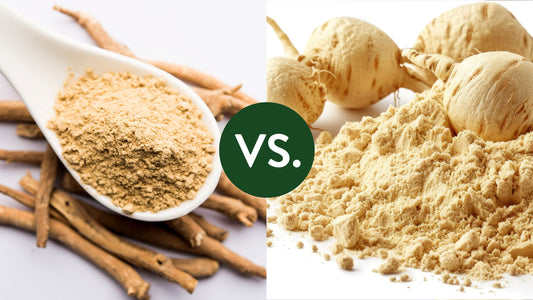
If you could choose only one supplement for adrenal support during menopause, maca root would be my number one favorite, and here’s a quick breakdown of why I love it so much.
Maca (Lepidium meyenii) is a Peruvian root vegetable that has been used for centuries at high altitudes where physical and environmental stress is extreme. It belongs to a category of plants sometimes called adaptogens, but it appears to work differently from most adaptogens.
Adaptogens help your body “adapt” to stress, mostly by reducing cortisol, the stress hormone.
But maca does more than just support healthy cortisol levels.
There are two main ways maca appears to support your hormones, too:
It supports the hypothalamic-pituitary-adrenal (HPA) axis to help regulate hormonal communication throughout the body, from the brain to the adrenals and the ovaries. (1)
It stops the breakdown of DHEA, which means more DHEA is available for sex hormone synthesis. (2)
This is why maca is a full-on hormonal support system, not just an adaptogen.
The science behind maca for menopause
The clinical evidence for maca in menopausal women is quite consistent.
A 2011 systematic review analyzed four randomized controlled trials and found that all four demonstrated the favorable effects of maca on menopausal symptoms using validated scoring tools, including the Kupperman Menopausal Index and the Greene Climacteric Scale. (3)
A series of double-blind, randomized, placebo-controlled trials published in the International Journal of Biomedical Science found that perimenopausal and early postmenopausal women taking gelatinized maca reported significant reductions in hot flashes, night sweats, and interrupted sleep, as well as improvements in mood and depression scores. (4,5)
And a separate randomized, double-blind, placebo-controlled 12-week study found that both black and red maca improved quality of life measures compared with placebo. (6)
And then there was a pilot study published in 2015 found that postmenopausal women taking maca experienced reductions in blood pressure and depression scores compared to placebo. (7)
Studies have also found measurable reductions in cortisol and ACTH (the pituitary hormone that drives cortisol production) in women taking maca. (4)
Maca for the adrenal glands and menopause
Women taking maca frequently report a notable lift in energy that doesn't feel like stimulant-driven jitteriness. It feels like restored vitality. The kind of energy that comes from your hormonal system actually functioning properly. This is what happens when you stop borrowing energy from your stress response.
Maca also supports mood stability, libido, and cognitive clarity, three areas where menopausal women often suffer most.
And of course, there’s the hot flash support, too.
Its effects tend to build over four to six weeks of consistent use, so patience is key.

2. Vitamin C
The adrenal glands contain one of the highest concentrations of vitamin C of any tissue in the body, and they use it in significant quantities during cortisol production.
When the adrenals are under chronic stress, vitamin C becomes depleted rapidly.
Supplementing helps replenish and support overall hormone synthesis.
Mighty Maca Plus includes ample vitamin C for this very reason.
3. B Vitamins, Especially B5 and B6
Pantothenic acid (B5) is directly involved in cortisol synthesis and adrenal function. B6 supports the conversion of amino acids into neurotransmitters and plays a role in hormonal balance more broadly.
A high-quality B-complex that includes meaningful doses of B5 and B6, alongside B12 and folate, provides the nutritional raw materials the adrenals need to function efficiently.
4. Magnesium
Magnesium is involved in over 300 enzymatic reactions in the body, including those that govern the stress response and adrenal hormone production. Many adults are deficient.
Low magnesium amplifies the cortisol response to stress, creating a reinforcing cycle of adrenal burden. Magnesium glycinate or threonate is well absorbed and typically well-tolerated.
Many women report that magnesium taken in the evening also significantly improves sleep quality.
5. Rhodiola Rosea
For women who want a plant-based adaptogen and are specifically looking for adrenal support without ashwagandha, rhodiola is an excellent alternative. Rhodiola has strong clinical evidence for reducing fatigue, improving stress resilience, and supporting energy without the sedating quality that some women experience with ashwagandha. (8)
It works best taken in the morning, as it can be mildly stimulating.
6. Phosphatidylserine
This phospholipid, found naturally in cell membranes, has solid research behind its ability to blunt the cortisol response to physical and psychological stress.
It essentially takes the edge off the stress signal before it reaches the adrenals, helping to keep cortisol production within a healthier range. It's particularly useful when adrenal issues are driven by high cortisol rather than depleted cortisol. (9)
What About Ashwagandha?
Ashwagandha is widely recommended for adrenal support and stress, and it does have genuine benefits for many people. However, it’s not at the top of my list.
Some women find it sedating, some experience digestive discomfort, and a small subset reports that it worsens hormonal symptoms, possibly due to its mild thyroid-stimulating effects.
If you've tried ashwagandha and didn't love how it felt, or simply prefer to avoid it, I prefer maca for menopausal adrenal support.
Putting It All Together: A Simple Adrenal Support Protocol
You don't need to take everything on this list. A focused, well-chosen protocol tends to outperform a scattered collection of supplements.
A strong starting point for most menopausal women would be maca (taken in the morning), a high-quality B-complex, magnesium in the evening, and vitamin C with meals. If stress and high cortisol are dominant issues, adding phosphatidylserine is worth considering. If fatigue and low resilience are the primary concerns, rhodiola pairs beautifully with maca.
Give any protocol at least six to eight weeks before evaluating its effects. Adrenal recovery is not an overnight process. It is the result of consistent, cumulative support.
Adrenal Support In Menopause
Your adrenals are a great backup support system for when your ovaries are winding down hormone production.
But that backup system only works when it isn't exhausted, overwhelmed, and stuck in permanent survival mode. Supporting your adrenals through nutrition, lifestyle, and targeted supplementation is a physiologically sound strategy for a smoother, more energetic, more hormonally balanced menopause.
Maca won't make the transition disappear. But for many women, it and the right supporting nutrients genuinely change what the transition feels like. More energy. More stability. More of you.

This article is for informational purposes only and is not intended as medical advice. Please consult a qualified healthcare provider before beginning any new supplement protocol, particularly if you are managing a health condition or taking medications.